Contributed Safety Item - K. Magness (Contributor)
Your car is in water and sinking. What do you do?
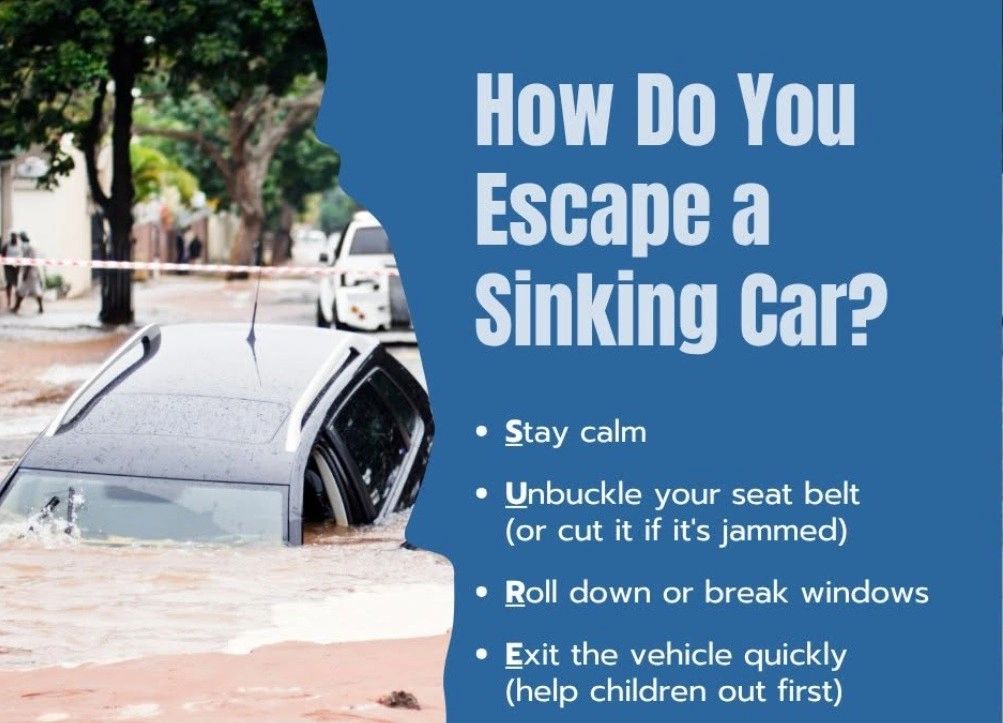
Contributed Safety Report
Do you know how to escape a sinking car?
Left: Quick steps to practice your escape from a car in the water. Note: These are basic steps. Each situation is different based on swift water or depth.
National Survey shows that most people do NOT know how to escape a sinking car.
To see a video of how to escape a sinking car - click here.
A new national survey reveals that most Americans are dangerously unprepared to escape a vehicle sinking in water, a scenario that kills more than 400 people in the U.S. each year. The survey was conducted as part of the Cooperative Congressional Election Study (CCES), featuring questions developed by The College of New Jersey’s Justice and Blameworthiness Lab (JABLab) in collaboration with Kids and Car Safety.
The research, conducted through the 2024 Cooperative Election Study (CCES) at Harvard University, surveyed 1,000 adults nationwide about their knowledge and confidence in surviving a vehicle submersion emergency. The findings show widespread misinformation, false confidence, and a lack of basic understanding about how little time there is to act.
“Many times, victims are dying from drowning trapped inside sinking vehicles because they did not get out in time,” said Amber Rollins, Executive Director of Kids and Car Safety. “When panicked, it can be extremely difficult to discern what to do, and with children in the vehicle, this challenge is even greater. This survey shows that far too many people are unprepared for those critical seconds, and that dangerous misconceptions are literally costing lives. We urgently need to make sure every driver knows what to do the instant their car hits the water. If you wait, your car becomes a coffin.”
“Our analysis shows that overconfidence and misinformation are pervasive, cutting across age, race, gender, and education levels,” said Elizabeth Borland, PhD, Professor of Sociology at The College of New Jersey and Director of JABLab. “Even highly educated adults frequently hold deadly beliefs about how to escape a submerged vehicle. This makes it clear that public safety campaigns cannot assume that knowledge comes automatically with education — targeted outreach and clear guidance are essential.”
Key Findings from the 2024 National Vehicle Submersion Survey
· Few are truly prepared: Only 3% of people were both confident and correct — while up to 43% were “confident but wrong,” the most dangerous group.
· Major knowledge gaps: Only 42.6% of Americans correctly identified that they must escape immediately through a window.
· Dangerous timing beliefs: Nearly 60% thought they had more than one minute to get out — though a sinking vehicle becomes unescapable once the water pressure begins pushing against the side windows. In most cases, this happens in about a minute.
· False confidence: Average confidence was 2.96/5, with many overestimating their ability to escape. Men and higher-educated respondents were more confident but not more accurate about how to escape.
· Persistent, deadly myths: Many still believe they should wait for the car to fill with water before exiting — a fatal misunderstanding that wastes precious time.
Misinformation Spans All Demographics
The study found that no demographic group is reliably prepared:
· Men and women had similar accuracy (~43%), but men were far more confident — and more likely to be wrong.
· Black and Asian respondents were least likely to correctly identify the escape method, with the “door myth” especially prevalent.
· Higher education correlated with greater confidence but not greater accuracy, showing that misinformation transcends education level.
· Parents were only slightly better informed, with 52% correctly saying children should exit first.
Call to Action: Remember “SWOC”
Kids and Car Safety urge all drivers to memorize the proven steps for escaping a sinking car — known as
SWOC:
S – Seat belts off
W – Windows open
O – Out immediately
C – Children first (oldest to youngest)
Because vehicles typically submerge within one minute, delaying action is deadly. There is no time to call 911 or wait for rescue. Knowing these steps before an emergency occurs can make the difference between life and death. Tragically, many victims who aren’t able to escape are found days, weeks, months or even years later deceased inside their vehicle.
About the Study
The 2024 Cooperative Election Study (CCES) is a nationally representative survey of 50,000 U.S. adults, hosted by Harvard University and administered by YouGov.
The vehicle submersion safety module — developed by The College of New Jersey’s Justice and Blameworthiness Lab (JABLab) and Kids and Car Safety — was fielded to a representative sample of 1,000 adults. Analysis of the data was conducted by JABLab’s Jenna Needham, under supervision of Dr. Borland.
Media Contacts:
Amber Rollins, Executive Director
Kids and Car Safety
(913) 205-6973
Elizabeth Borland, PhD
Professor of Sociology, Department of Sociology and Anthropology, The College of New Jersey
Jenna Needham
Research Assistant, Justice and Blameworthiness Lab, The College of New Jersey
ids and Car Safety is a national nonprofit organization dedicated to saving the lives of children in and around vehicles through data collection, research and analysis, public education and awareness programs, policy change, product redesign and supporting families to channel their grief into positive change. As an independent nonprofit, we rely on donations and community support to continue this critical work. To support our mission, visit https://kidsandcars.networkforgood.com/projects/140012-kids-and-car-safety